
Introduction
The NORCET 2026 syllabus for Child Health Nursing, Mental Health Nursing, Community Health Nursing, Educational Technology, and Forensic Nursing equips nursing aspirants with the knowledge and practical skills required to provide holistic patient care. These subjects emphasize developmental, psychological, educational, and community-based aspects of healthcare while introducing legal and ethical responsibilities essential to modern nursing practice.
Overview
Child Health Nursing focuses on growth and development, neonatal care, immunization, and management of childhood illnesses and emergencies. Mental Health Nursing covers psychiatric disorders, therapeutic communication, assessment, and treatment modalities. Community Health Nursing emphasizes public health programs, environmental sanitation, epidemiology, communicable and non-communicable diseases, and school health services. Educational Technology and Nursing Education prepare nurses for teaching, curriculum development, assessment, and evidence-based learning. Forensic Nursing introduces forensic science, evidence preservation, legal procedures, victims’ rights, and the role of nurses in medico-legal care.
Section 1: Course Overviews
1. Child Health Nursing – I
This course transitions you from adult care into developmental pediatrics. You will analyze pediatric anatomical, physiological, and immunological differences that dictate a child’s unique response to illness. Key competencies include mastering developmental theories (Piaget, Erikson), managing the cold chain within the Universal Immunization Program, and calculating precise pediatric fluid and medication dosages. You will learn to perform specialized clinical appraisals for normal newborns and low-birth-weight babies (Kangaroo Mother Care), manage critical conditions like Respiratory Distress Syndrome, and apply pediatric pain scales (FLACC, FACES). Clinical algorithms like IMNCI and AHA PALS guidelines provide the foundation for managing childhood respiratory, endocrine, and emergency situations.
2. Mental Health Nursing – I
This specialty explores psychiatric conditions by examining the structural, limbic, and neurotransmitter pathways of the brain. You will master the diagnostic criteria of the DSM-5 and ICD-11 to assess and manage major psychiatric conditions, including Schizophrenia, Bipolar Affective Disorder, major depression, and various anxiety or stress-related disorders. A major focus is placed on establishing a therapeutic nurse-patient relationship, executing complete Mental Status Examinations (MSE), and safely managing advanced treatment modalities. These modalities range from psychopharmacology and Electroconvulsive Therapy (ECT) to behavioral, cognitive (CBT), and milieu therapies.
3. Community Health Nursing – I
Bridging environmental science, clinical care, and epidemiology, this course prepares you for primary health care delivery within India’s infrastructure (Health & Wellness Centres, PHCs). You will study disease causation models, investigate epidemics, and execute national health programs targeting communicable vector-borne vectors (Malaria, Dengue), infectious diseases (TB, Leprosy), and rising Non-Communicable Diseases (Diabetes, Hypertension, Cancers). Operational skills include performing family nutritional assessments, executing the household “bag technique” during home visits, managing school health services, and utilizing community resources to address complex socio-environmental issues affecting public health.
4. Educational Technology & Nursing Education
This NORCET 11 Syllabus 2026 unit introduces the theory and structural philosophy behind teaching and learning. You will compare classic educational philosophies—such as Realism, Pragmatism, and Idealism—and analyze how they shape modern nursing curriculum design. The course emphasizes contemporary, student-centric methodologies, specifically focusing on Competency-Based Education (CBE), transformational learning, and relationship-based instruction to prepare you for future roles in clinical instruction, patient education, and nursing mentorship.
Section 2: Detailed Subject Syllabus
Semester V: Child Health Nursing – I
| Unit | Content |
| I | Introduction: Modern concepts of child-care • Historical development of child health • Philosophy and modern concept of child-care • Cultural and religious considerations in child-care • National policy and legislations in relation to child health and welfare • National programs and agencies related to welfare services to the children • Internationally accepted rights of the child • Changing trends in hospital care, preventive, promotive and curative aspect of child health • Preventive pediatrics: ◦ Concept ◦ Immunization ◦ Immunization programs and cold chain. ◦ Care of under-five and Under-five Clinics/Well-baby clinics |
| II | • Preventive measures towards accidents • Child morbidity and mortality rates • Difference between an adult and child which affect response to illness: ◦ Physiological ◦ Psychological ◦ Social ◦ Immunological • Hospital environment for sick child • Impact of hospitalization on the child and family • Communication techniques for children • Grief and bereavement • The role of a child health nurse in caring for a hospitalized child • Principles of pre and postoperative care of infants and children. • Child Health Nursing procedures: ◦ Administration of medication: oral, I/M, & I/V ◦ Calculation of fluid requirement ◦ Application of restraints ◦ Assessment of pain in children: ▪ FACES pain rating scale ▪ FLACC scale ▪ Numerical scale • The Healthy Child: ◦ Definition and principles of growth and development ◦ Factors affecting growth and development ◦ Growth and development from birth to adolescence ◦ Growth and developmental theories (Freud, Erickson, Jean Piaget, Kohlberg) ◦ The needs of normal children through the stages of developmental and parental guidance ◦ Nutritional needs of children and infants: ▪ breast feeding ▪ exclusive breast feeding ▪ Supplementary/artificial feeding and weaning ◦ Baby friendly hospital concept ◦ Types and value of play and selection of play material |
| III | Nursing care of neonate: • Appraisal of Newborn • Nursing care of a normal newborn/essential newborn care • Neonatal resuscitation • Nursing management of low birth weight baby • Kangaroo mother care • Nursing management of common neonatal disorder: ◦ Hyperbilirubinemia ◦ Hypothermia ◦ Hyperthermia ◦ Metabolic disorder ◦ Neonatal infections ◦ Neonatal seizures ◦ Respiratory distress syndrome ◦ Retinopathy of Prematurity • Organization of neonatal care unit • Neonatal equipment |
| IV | Integrated management of neonatal and childhood Illnesses |
| V | Nursing management in common childhood diseases Respiratory system: • Identification and Nursing management of congenital malformations • Congenital disorders: Tracheoesophageal fistula, Diaphragmatic hernia • Others: Acute naso-pharyngitis, Tonsillitis, Croup, Bronchitis, Bronchiolitis, Pneumonia, Asthma Endocrine system: • Juvenile Diabetes mellitus, Hypo-thyroidism |
| VI | Childhood emergencies • Accidents – causes and prevention, Poisoning, Foreign bodies, Hemorrhage, Burns and Drowning • PLS (AHA Guidelines) |
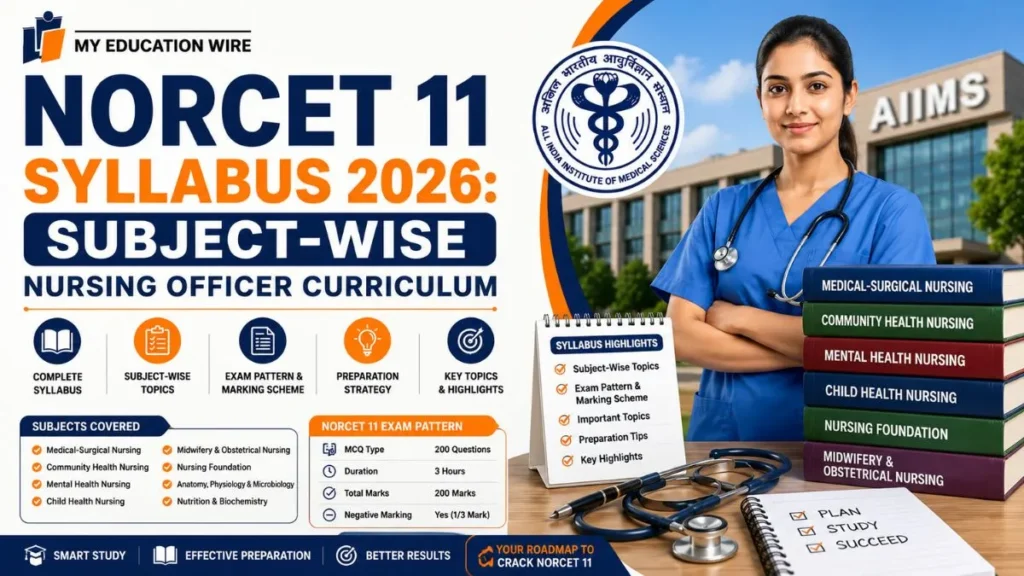
Reviewing the NORCET syllabus 2026 in detail can help you understand the AIIMS NORCET 11 Exam Syllabus.
Mental Health Nursing – I
| Unit | Content |
| I | Introduction • Perspectives of Mental Health and Mental Health Nursing, evolution of mental health services, treatments and nursing practices • Mental health team • Nature & scope of mental health nursing • Role & functions of mental health nurse in various settings and factors affecting the level of nursing practice • Concepts of normal and abnormal behaviour |
| II | Principles and Concepts of Mental Health Nursing • Definition: mental health nursing and terminology used • Classification of mental disorders: ICD11, DSM5, Geropsychiatry manual classification • Review of personality development, defense mechanisms • Etiology bio-psycho-social factors • Psychopathology of mental disorders: review of structure and function of brain, limbic system and abnormal neurotransmission • Principles of Mental health Nursing • Ethics and responsibilities • Practice Standards for Psychiatric Mental Health Nursing (INC practice standards) • Conceptual models and the role of nurse: ◦ Existential model ◦ Psychoanalytical models ◦ Behavioural model ◦ Interpersonal model • Preventive psychiatry and rehabilitation |
| III | Mental Health Assessment • History taking • Mental status examination • Mini mental status examination • Neurological examination • Investigations: Related Blood chemistry, EEG, CT & MRI • Psychological tests |
| IV | Therapeutic Communication and Nurse-Patient Relationship • Therapeutic communication: Types, techniques, characteristics and barriers • Therapeutic nurse-patient relationship • Interpersonal relationship- • Elements of nurse patient contract, • Review of technique of IPR- Johari window • Therapeutic impasse and its management |
| V | Treatment modalities and therapies used in mental disorders • Physical therapies: Psychopharmacology, • Electro Convulsive therapy • Psychological Therapies: Psychotherapy, Behaviour therapy, CBT • Psychosocial: Group therapy, Family therapy, Therapeutic Community, Recreational therapy, Art therapy (Dance, Music etc), Occupational therapy • Alternative & Complementary: Yoga, Meditation, Relaxation • Consideration for special populations |
| VI | Nursing management of patient with Schizophrenia, and other psychotic disorders • Prevalence and incidence • Classification • Etiology, psychodynamics, clinical manifestation, diagnostic criteria/formulations • Nursing process: ◦ Nursing Assessment: History, Physical and mental assessment • Treatment modalities and nursing management of patients with Schizophrenia and other psychotic disorders • Geriatric considerations and considerations for special populations • Follow up and home care and rehabilitation |
| VII | Nursing management of patient with mood disorders • Prevalence and incidence • Mood disorders: Bipolar affective disorder, mania depression and dysthymia etc. • Etiology, psycho dynamics, clinical manifestation, diagnosis • Nursing Assessment History, Physical and mental assessment • Treatment modalities and nursing management of patients with mood disorders • Geriatric considerations/ considerations for special populations • Follow-up and home care and rehabilitation |
| VIII | Nursing management of patient with neurotic, stress related and somatisation disorders • Prevalence and incidence • classifications • Anxiety disorders – OCD, PTSD, Somatoform disorders, Phobias, Disassociative and Conversion disorders • Etiology, psychodynamics, clinical manifestation, diagnostic criteria/ formulations • Nursing Assessment: History, Physical and mental assessment • Treatment modalities and nursing management of patients with neurotic and stress related disorders • Geriatric considerations/ considerations for special populations • Follow-up and home care and rehabilitation |
Community Health-I (Including Environmental Science and Epidemiology)
| Unit | Content |
| I | Concepts of Community Health and Community Health Nursing • NORCET Nursing Officer Syllabus also provide Definition of public health, community health and community health nursing • Public health in India and its evolution and Scope of community health nursing • Review: Concepts of Health & Illness/ disease: Definition, dimensions and determinants of health and disease • Natural history of disease • Levels of prevention: Primary, Secondary & tertiary prevention – Review • Health problems (Profile) of India |
| II | Health Care Planning and Organization of Health Care at various levels • Health planning steps • Health planning in India: various committees and commissions on health and family welfare and Five Year plans • Participation of community and stakeholders in health planning • Health care delivery system in India: Infrastructure and Health sectors, Delivery of health services at sub-centre (SC), PHC, CHC, District level, state level and national level • Sustainable development goals (SDGs), Primary Health Care and Comprehensive Primary Health Care (CPHC): elements, principles • CPHC through SC/Health Wellness Center (HWC) • Role of MLHP/CHP • National Health Care Policies and Regulations: ◦ National Health Policy (1983, 2002, 2017) ◦ National Health Mission (NHM): National Rural Health Mission (NRHM), National Urban Health Mission (NUHM), NHM Mission (NUHM), NHM ◦ National Health Protection Mission (NHPM) ◦ Ayushman Bharat ◦ Universal Health Coverage |
| III | Environmental Science, Environmental Health, and Sanitation • Natural resources: Renewable and non-renewable resources, natural resources and associated problems: Forest resources, water resources, mineral resources, food resources, energy resources and land resources • Role of individuals in conservation of natural resources, and equitable use of resources for sustainable lifestyles • Ecosystem: Concept, structure and functions of ecosystems, Types & Characteristics – Forest ecosystem, Grassland ecosystem, Desert ecosystem, Aquatic ecosystem, Energy flow in ecosystem • Biodiversity: Classification, value of bio-diversity, threats to biodiversity, conservation of biodiversity • Environmental pollution: Introduction, causes, effects and control measures of Air pollution, Water pollution, Soil pollution, Marine pollution, Noise pollution, Thermal pollution, nuclear hazards & their impact on health • Climate change, global warming: ex. heat wave, acid rain, ozone layer depletion, waste land reclamation & its impact on health • Social issues and environment: sustainable development, urban problems related to energy, water and environmental ethics • Acts related to environmental protection and preservation Environmental Health & Sanitation: • Concept of environment health and sanitation • Concept of safe water, sources of water, waterborne diseases, water purification processes, household purification of water • Physical and chemical standards of drinking water quality and tests for assessing bacteriological quality of water • Concepts of water conservation: rain water harvesting and water shed management • Solid waste management, human excreta disposal & management and sewage disposal and management • Commonly used insecticides and pesticides • Explain waste management |
| IV | Nutrition Assessment and Nutrition Education • Review of Nutrition: ◦ Concepts, types ◦ Meal planning: aims, steps & diet plan for different age groups ◦ Nutrition assessment of individuals, families and community by using appropriate methods • Planning suitable diet for individuals and families according to local availability of foods, dietary habits and economic status • General nutritional advice • Nutrition education: purpose, principles & methods and Rehabilitation • Review: Nutritional deficiency disorders • National nutritional policy & programs in India Food Borne Diseases and Food Safety: • Food borne diseases: ◦ Definition, & burden, Causes and classification ◦ Signs & Symptoms ◦ Transmission of food borne pathogens & toxins ◦ Early identification, initial management and referral • Food poisoning & food intoxication: ◦ Epidemiological features/clinical characteristics, Types of food poisoning ◦ Food intoxication-features, preventive & control measures ◦ Public health response to food borne diseases |
| V | Communication management and Health Education • Behaviour change communication skills |
| VI | Community health nursing approaches, concepts, roles and responsibilities of community health nursing personnel • Approaches: ◦ Nursing process ◦ Epidemiological approach ◦ Problem solving approach ◦ Evidence based approach ◦ Empowering people to care for themselves • Review: Primary health care and Comprehensive Primary Health Care (CPHC) • Home Visits: ◦ Concept, Principles, Process, & Techniques: Bag technique • Qualities of Community Health Nurse • Roles and responsibilities of community health nursing personnel in family health services • Review: Principles & techniques of counseling |
| VII | Assisting individuals and families to promote and maintain their health A. Assessment of individuals and families (Review from Child health nursing, Medical surgical nursing and OBG Nursing) • Assessment of children, women, adolescents, elderly etc. • Children: Monitoring growth and development, milestones, anthropometric measurements, BMI • Social development • Temperature and Blood pressure monitoring • Menstrual cycle • Breast self-examination (BSE) and testicles self-examination (TSE) • Warning Signs of various diseases • Tests: Urine for sugar and albumin, blood sugar, Hemoglobin B. Provision of health services/primary health care: • Routine check-up, Immunization, counseling, and diagnosis • Management of common diseases at home and health centre level ◦ Care based on standing orders/protocols approved by MoH&FW and INC regulation ◦ Drugs dispensing and injections at health centre C. Continue medical care and follow up in community for various diseases/disabilities D. Carry out therapeutic procedures as prescribed/required for client and family E. Maintenance of health records and reports • Maintenance of client records • Maintenance of health records at the facility level • Report writing and documentation of activities carried out during home visits, in the clinics/centers and field visits F. Sensitize and handle social issues affecting health and development of the family • Women empowerment • Women and child abuse • Abuse of elders • Female foeticide • Commercial sex workers • Substance abuse G. Utilize community resources for client and family • Trauma services • Old age homes • Orphanages |
| VIII | Introduction to Epidemiology – Epidemiological Approaches and Processes • Epidemiology: Concept and Definition • Distribution and frequency of disease • Aims & uses of epidemiology • Epidemiological models of causation of disease • Concepts of disease transmission • Modes of transmission: Direct, Indirect and chain of infection • Time trends or fluctuations in disease occurrence • Epidemiological approaches: Descriptive, analytical and experimental • Principles of control measures/levels of prevention of disease • Investigation of an epidemic of communicable disease • Use of basic epidemiological tools to make community diagnosis for effective planning and intervention |
| IX | Communicable Diseases and National Health Programs 1. Communicable Diseases – Vector borne diseases (Every disease will be dealt under the following headlines) • Epidemiology of the following vector borne diseases • Prevention & control measures • Screening, and diagnosing the following conditions, primary management, referral and follow up ◦ Malaria, Filaria, Kala-azar, Japanese encephalitis, Dengue, Chickungunya 2. Communicable diseases: Infectious diseases (Every disease will be dealt under the following headlines) • Epidemiology of the following infectious diseases • Prevention & Control measures • Screening, diagnosing the following conditions, primary management, referral and follow up ◦ Leprosy, Tuberculosis ◦ Vaccine preventable diseases – Diphtheria, whooping cough, tetanus, poliomyelitis and measles ◦ Enteric fever, Viral hepatitis, HIV/AIDS/RTI infections ◦ HIV/AIDS, and Sexually Transmitted Diseases/ Reproductive tract infections (STIs/RTIs) ◦ Diarrhoea, Respiratory tract infections, COVID-19 ◦ Helminthic – soil & food transmitted and parasitic infections – Scabies and pediculosis 3. Communicable diseases: Zoonotic diseases • Epidemiology of Zoonotic diseases • Prevention & control measures • Screening and diagnosing the following conditions, primary management, referral and follow up ◦ Rabies: Identify, suspect, primary management and referral to a health facility • Role of a nurses in control of communicable diseases National Health Programs: 1. UIP: Universal Immunization Program (Diphtheria, Whooping cough, Tetanus, Poliomyelitis, Measles and Hepatitis B) 2. National Leprosy Eradication Program (NLEP) 3. Revised National Tuberculosis Control Program (RNTCP) 4. Integrated Disease Surveillance Program (IDSP): Enteric fever, Diarrhea, Respiratory infections and Scabies 5. National Aids Control Organization (NACO) 6. National Vector Borne Disease Control Program |
| X | Non-Communicable Diseases and National Health Program (NCD) • National response to NCDs (Every disease will be dealt under the following headlines) • Epidemiology of specific diseases • Prevention and control measures • Screening, diagnosing/identification and primary management, referral and follow up care NCD-1 • Diabetes Mellitus, Hypertension, Cardiovascular diseases, Stroke & Obesity • Blindness: Categories of visual impairment and national program for control of blindness • Deafness: national program for prevention and control of deafness • Thyroid diseases • Injury and accidents: Risk factors for Road traffic injuries and operational guidelines for trauma care facility on highways NCD-2 Cancers • Cervical Cancer, Breast Cancer, Oral cancer • Epidemiology of specific cancers, Risk factors/ Causes, Prevention, Screening, diagnosis – signs, Signs & symptoms, and early management & referral • Palliative care • Role of a nurse in non-communicable disease control program National Health Programs: • National program for prevention and control of cancer, Diabetes, Cardiovascular Diseases and Stroke (NPCDCS) • National program for control of blindness • National program for prevention and control of deafness 7. National Air Quality Monitoring Program 8. Any other newly added program • National tobacco control program • Standard treatment protocols used in National Health Programs |
| XI | School Health Services • Objectives • Health problems of school children • Components of school health services • Maintenance of school health records • Initiation and planning of school health services • Role of a school health nurse |
Educational Technology & Nursing Education
| Unit | Content |
| I | Introduction and Theoretical Foundations: • Education and educational technology • Definition, aims • Approaches and scope of educational technology • Latest approaches to education: ◦ Transformational education ◦ Relationship based education ◦ Competency based education |
| II | Educational philosophy: • Definition of philosophy, education and philosophy • Comparison of educational philosophies • Philosophy of nursing education Teaching learning process: • Definitions • Teaching learning as a process • Nature and characteristics of teaching and learning • Principles of teaching and learning • Barriers to teaching and learning • Learning theories • Latest approaches to learning: ◦ Experiential learning, Reflective learning, Scenario based learning, Simulation based learning, Blended learning Assessment and Planning: • Assessment of teacher: ◦ Essential qualities of a teacher ◦ Teaching styles – Formal authority, demonstrator, facilitator, delegator • Assessment of learner: ◦ Types of learners ◦ Determinants of learning – learning needs, readiness to learn, learning styles ◦ Today’s generation of learners and their skills and attributes ◦ Emotional intelligence of the learner ◦ Motivational factors – personal factors, environmental factors and support system Curriculum Planning: • Curriculum – definition, types • Curriculum design – components, approaches • Curriculum development – factors influencing curriculum development, facilitators and barriers • Writing learning outcomes/behavioral objectives • Basic principles of writing course plan, unit plan and lesson plan |
| III & IV | Implementation • Teaching in Classroom and Skill lab – Teaching Methods • Classroom management- principles and strategies • Classroom communication: ◦ Facilitators and Barriers to classroom communication ◦ Information communication technology (ICT) – ICT used in education • Teaching methods – Features, advantages and disadvantages: ◦ Lecture, Group discussion, microteaching ◦ Skill lab – simulations, Demonstration & re-demonstration ◦ Symposium, panel discussion, seminar, scientific workshop, exhibitions ◦ Role play, project, Field trips ◦ Self-directed learning (SDL), Computer assisted learning, One-to-one instruction Active learning strategies: • Team based learning, Problem based learning, Peer sharing, Case study analysis, Journaling, Debate, Gaming, Inter-professional education |
| V | Teaching in the Clinical Setting – Teaching Methods • Clinical learning environment • Factors influencing selection of clinical learning experiences • Practice model • Characteristics of effective clinical teacher • Writing clinical learning outcomes/practice competencies • Clinical teaching strategies: patient assignment – clinical conference, clinical presentation/bedside clinic, Case study/care study, nursing rounds, concept mapping, project, debate, game, role play, PBL, questioning, written assignment, process recording Educational/Teaching Media: • Media use – Purpose, components, principles and steps • Types of media: ◦ Still visuals: ▪ Non projected – drawings & diagrams, charts, graphs, posters, cartoons, board devices (chalk/white board, bulletin board, flannel board, flip charts, flash cards, still pictures/photographs, printed materials-handout, leaflet, brochure, flyer) ▪ Projected – film stripes, microscope, power point slides, overhead projector ◦ Moving visuals: ▪ Video learning resources – videotapes & DVD, blu-ray, USB flash drive ▪ Motion pictures/films ◦ Realia and models: Real objects & Models ◦ Audio aids/audio media: Audiotapes/Compact discs, Radio & Tape recorder, Public address system, Digital audio ◦ Electronic media/computer learning resources: Computers, Web-based videoconferencing, E-learning, Smart classroom ◦ Telecommunication (Distance education): Cable TV, satellite broadcasting, videoconferencing Telephones – Telehealth/telenursing ◦ Mobile technology |
| VI & VII | Assessment/Evaluation Methods/Strategies • Purposes, scope and principles in selection of assessment methods and types • Barriers to evaluation • Guidelines to develop assessment tests • Assessment of knowledge: Essay type questions, Short answer questions (SAQ), Multiple choice questions (MCQ – single response & multiple response) • Assessment of skills: Clinical evaluation, Observation (checklist, rating scales, videotapes), Written communication – progress notes, nursing care plans, process recording, written assignments, Verbal communication (oral examination), Simulation, Objective Structured Clinical Examination (OSCE), Self-evaluation, Clinical portfolio, clinical logs • Assessment of Attitude: Attitude scales • Assessment tests for higher learning: Interpretive questions, hot spot questions, drag and drop and ordered response questions Guidance/academic advising, counseling and discipline: • Guidance: Definition, objectives, scope, purpose and principles ◦ Roles of academic advisor/faculty in guidance • Counseling: Difference between guidance and counseling ◦ Definition, objectives, scope, principles, types, process and steps of counseling ◦ Counseling skills/techniques – basics ◦ Roles of counselor ◦ Organization of counseling services ◦ Issues for counseling in nursing students • Discipline and grievance in students: ◦ Managing disciplinary/grievance problems – preventive guidance & counseling ◦ Role of students’ grievance redressal cell/committee |
| VIII | Ethics and Evidence Based Teaching (EBT) in Nursing Education • Ethics – Review: ◦ Definition of terms ◦ Value based education in nursing ◦ Value development strategies ◦ Ethical decision making ◦ Ethical standards for students ◦ Student-faculty relationship • Evidence based teaching – Introduction: ◦ Evidence based education process and its application to nursing education |
Introduction to Forensic Nursing and Indian Laws
| Unit | Content |
| I | Forensic Science • Definition, History, Importance in medical science, Forensic Science Laboratory Violence • Definition, Epidemiology, Source of data, Sexual abuse – child and women |
| II | Forensic Nursing • Definition, History and development • Scope – setting of practice, areas of practice and subspecialties • Ethical issues • Roles and responsibilities of nurse • INC & SNC Acts |
| III | Forensic Team • Members and their roles Comprehensive forensic nursing care of victim and family • Physical aspects, Psychosocial aspects, Cultural and spiritual aspects, Legal aspects • Assist forensic team in care beyond scope of her practice • Admission and discharge/referral/death of victim of violence • Responsibilities of nurse as a witness Evidence preservation – role of nurses • Observation, Recognition, Collection, Preservation • Documentation of Biological and other evidence related to criminal/traumatic event • Forwarding biological samples for forensic examination |
| IV | Introduction of Indian Constitution Fundamental Rights • Rights of victim, Rights of accused Human Rights Commission |
| V | Sources of laws and law-making powers Overview of Indian Judicial System • JMFC (Judicial Magistrate First Class), District, State, Apex Civil and Criminal Case Procedures • IPC (Indian Penal Code), ICPC, IE Act (Indian Evidence Act) Overview of POSCO Act |
Conclusion
Together, these subjects provide a comprehensive foundation for professional nursing practice. Mastering these areas enhances clinical competence, communication skills, public health awareness, educational abilities, and legal understanding. A thorough preparation of these topics is essential for success in NORCET 2026 and for delivering safe, ethical, and quality healthcare services.