

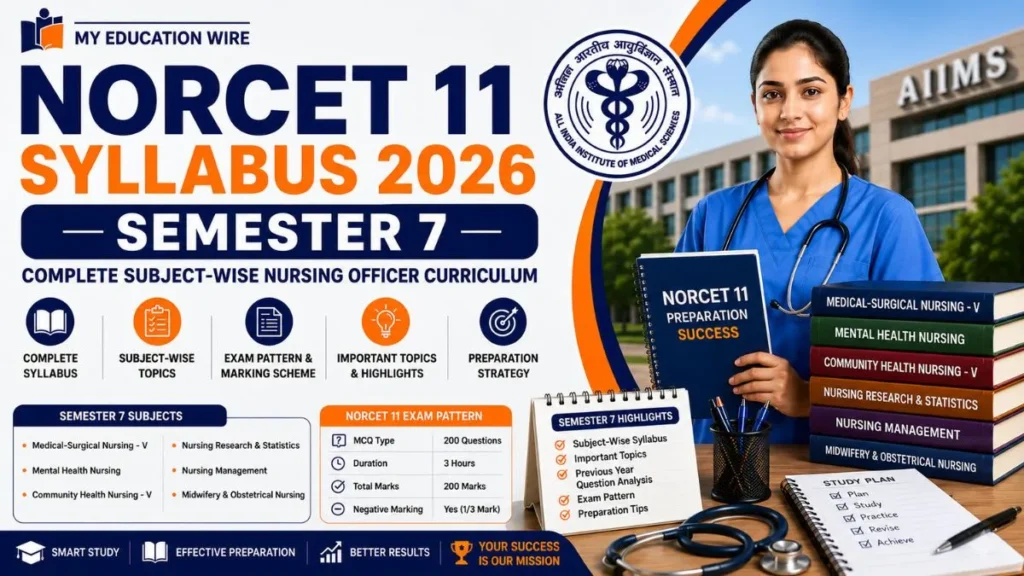
Semester VII
- Community Health Nursing II: Covers the community-level primary care and referral pathways for various system-based ailments (Gastrointestinal, Respiratory, Urinary, and Cardiac) alongside first aid emergency management. It emphasizes maternal, newborn, and adolescent care (including RMNCH+A, family planning, and MTP acts) while addressing foundational concepts in health data surveillance (HMIS), occupational hazards, geriatric health, national mental health programs, leadership protocols, disaster management, and biomedical waste regulations.
- Nursing Research and Statistics: Introduces the framework of the scientific method and evidence-based practice (EBP). It details the construction of problem statements, data collection methodologies, sampling techniques, research ethics, and basic statistical analysis—spanning central tendency measurements, correlation, and tests of significance—concluding with research report compilation and utilization.
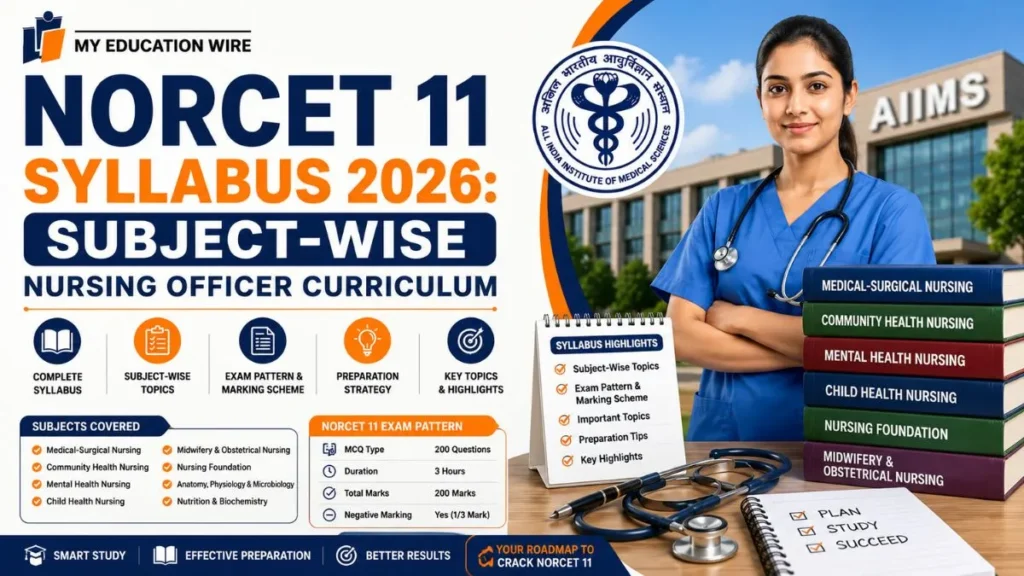
- Midwifery/Obstetrics and Gynaecology Nursing II: The Norcet Exam Syllabus 2026 portrayed extensively in the referenced curriculum images (WhatsApp Image 2026-06-11 at 2.59.12 PM.jpeg, WhatsApp Image 2026-06-11 at 2.59.12 PM (1).jpeg, and WhatsApp Image 2026-06-11 at 2.59.12 PM (2).jpeg), this segment handles surgical labor interventions, postpartum complications (like sepsis and hemorrhage), high-risk newborn care workflows (such as KMC and neonatal resuscitation guidelines), and the clinical management of common gynecological disorders, infertility, and reproductive tract tumors.
Nursing Research and Statistics Detailed Table
| Unit | Content |
| I | Research and Research Process • Introduction and need for nursing research • Definition of Research & nursing research • Steps of scientific method • Characteristics of good research • Steps of Research process – overview • Evidence Based Practice – Concept, Meaning, Purposes, Steps of EBP Process and Barriers |
| II | Research Problem/Question • Identification of problem area • Problem statement • Criteria of a good research problem • Writing objectives and hypotheses |
| III | Review of Literature • Location • Sources • On line search; CINHAL, COCHRANE etc. • Purposes • Method of review |
| IV | Research Approaches and Designs • Historical, survey and experimental • Qualitative and Quantitative designs |
| V | Sampling and data Collection • Definition of Population, Sample • Sampling criteria, factors influencing sampling process, types of sampling techniques • Data – why, what, from whom, when and where to collect • Data collection methods and instruments o Methods of data collection o Questioning, interviewing o Observations, record analysis and measurement o Types of instruments, Validity & Reliability of the Instrument • Research ethics • Pilot study • Data collection procedure |
| VI | Analysis of data • Compilation, Tabulation, classification, summarization, presentation, interpretation of data |
| VII | Introduction to Statistics • Definition, use of statistics, scales of measurement. • Frequency distribution and graphical presentation of data • Mean, Median, Mode, Standard deviation • Normal Probability and tests of significance • Co-efficient of correlation • Statistical packages and its application |
| VIII | Communication and utilization of Research • Communication of research findings • Verbal report • Writing research report • Writing scientific article/paper • Critical review of published research including publication ethics • Utilization of research findings • Conducting group research project |
Midwifery/Obstetrics and Gynaecology Nursing II Detailed Table
| Unit | Content |
| I | Recognition and Management of problems during Pregnancy • Assessment of high-risk pregnancy Problems/Complications of Pregnancy • Hyper-emesis gravidarum, • Bleeding in early pregnancy – abortion, ectopic pregnancy, vesicular mole • Unintended or mistimed pregnancy • Post abortion care & counseling • Bleeding in late pregnancy placenta previa, abruption placenta, trauma • Medical conditions complicating pregnancy – Anemia, PIH/Pre-eclampsia, Eclampsia, GDM, cardiac disease, pulmonary disease, thyrotoxicosis, STDs, HIV, Rh incompatibility |
| II | (Content continued from Unit I medical conditions…) • Infections in pregnancy – urinary tract infection, bacterial, viral, protozoal, fungal, malaria in pregnancy • Surgical conditions complicating pregnancy – appendicitis, acute abdomen • COVID-19 & pregnancy and children • Hydramnios • Multiple pregnancy • Abnormalities of placenta and cord • Intra uterine growth restriction • Intra uterine fetal death • Gynaecological conditions complicating pregnancy • Mental health issues during pregnancy • Adolescent pregnancy • Elderly primi, grand multiparity • Management and care of conditions as per the GoI protocol • Policy for the referral services • Drugs used in management of high-risk pregnancies • Maintenance of records and reports Recognition and management of abnormal labour for NORCET 11 Syllabus 2026 • Preterm labour – Prevention and management of preterm labour; (Use of antenatal corticosteroids in preterm labour) • Premature rupture of membranes • Malposition’s and abnormal presentations (posterior position, breech, brow, face, shoulder) • Contracted Pelvis, Cephalo Pelvic Disproportion (CPD) • Disorders of uterine action – Prolonged labour, Precipitate labour, Dysfunctional labour • Complications of third stage – Retained placenta, Injuries to birth canal, Postpartum hemorrhage (bimanual compression of the uterus, aortic compression, uterine balloon tamponade) • Obstetric emergencies – Foetal distress, Ruptured uterus, Cord prolapse, Shoulder dystocia, Uterine inversion, Vasa previa, Obstetrical shock, Amniotic fluid embolism • Episiotomy and suturing • Obstetric procedures – Forceps delivery, Vacuum delivery, Version • Induction of labour – Medical & surgical |
| III | • Caesarean section – indications and preparation • Nursing management of women undergoing obstetric operations and procedures • Drugs used in management of abnormal labour • Anesthesia and analgesia in obstetrics Recognition and Management of postnatal problems • Physical examination, identification of deviation from normal • Puerperal complications and its management o Puerperal pyrexia o Puerperal sepsis o Urinary complications o Secondary Postpartum hemorrhage o Vulval hematoma o Breast engorgement including mastitis/breast abscess, feeding problem o Thrombophlebitis o DVT o Uterine sub involution o Vesico vaginal fistula (VVF), Recto vaginal fistula (RVF) o Postpartum depression/psychosis • Drugs used in abnormal puerperium • Policy about referral |
| IV | Assessment and management of High-risk newborn (Review) • Models of newborn care in India – NBCC; SNCUs • Screening of high-risk newborn • Protocols, levels of neonatal care, infection control • Prematurity, Post-maturity • Low birth weight • Kangaroo Mother Care • Birth asphyxia/Hypoxic encephalopathy • Neonatal sepsis • Hypothermia • Respiratory distress • Jaundice • Neonatal infections • High fever • Convulsions • Neonatal tetanus • Congenital anomalies • Baby of HIV positive mothers • Baby of Rh negative mothers • Birth injuries • SIDS (Sudden Infant Death Syndrome) prevention, Compassionate care • Calculation of fluid requirements, EBM/formula feeds/tube feeding • Home based newborn care program – community facility integration in newborn care • Decision making about management and referral • Bereavement counseling • Drugs used for high risk newborns • Maintenance of records and reports |
| V | Assessment and management of women with gynecological disorders • Gynecological assessment – History and Physical assessment • Breast Self-Examination • Congenital abnormalities of female reproductive system • Etiology, pathophysiology, clinical manifestations, diagnosis, treatment modalities and management of women with: o Menstrual abnormalities o Abnormal uterine bleed o Pelvic inflammatory disease o Infections of the reproductive tract o Uterine displacement o Endometriosis o Uterine and cervical fibroids and polyps o Tumors – uterine, cervical, ovarian, vaginal, vulval o Cysts – ovarian, vulval o Cystocele, urethrocele, rectocele o Genitor-urinary fistulas o Breast disorders – infections, deformities, cysts, tumors o HPV vaccination o Disorders of Puberty and menopause o Hormonal replacement therapy • Assessment and management of couples with infertility o Infertility – definition, causes o Counseling the infertile couple o Investigations – male and female o Artificial reproductive technology o Surrogacy, sperm and ovum donation, cryopreservation • Adoption – counseling, procedures • Injuries and Trauma; Sexual violence • Drugs used in treatment of gynaecological disorders |
Read the complete NORCET 11 Semester wise Syllabus 2026 here.