

B.Sc Nursing is one of the most sought-after healthcare programs in India, providing students with the knowledge, skills, and clinical expertise required to deliver quality patient care. The four-year undergraduate nursing program follows a semester-based curriculum designed by the Indian Nursing Council (INC) to prepare future nurses for hospital, community, research, and leadership roles.
For aspirants preparing for AIIMS NORCET Exam 2026, understanding the NORCET 11 Nursing Syllabus 2026 is extremely important because a significant portion of the examination is based on nursing subjects taught throughout the degree. This article provides a semester-wise overview of the complete B.Sc Nursing syllabus.
Semester I: Building the Foundation of Nursing Sciences
The NORCET 11 first semester syllabus 2026 introduces students to the fundamentals of human health, communication, and behavioral sciences.
Communicative English and Soft Skills
Students develop Listening, Speaking, Reading, and Writing (LSRW) skills, professional communication techniques, patient interaction strategies, documentation methods, conflict management, and interpersonal relationship skills.
Applied Anatomy
This subject focuses on the structure of the human body, including the musculoskeletal, cardiovascular, respiratory, digestive, nervous, endocrine, reproductive, and urinary systems. Students learn anatomical positions, planes, movements, tissues, and organ structures.
Applied Physiology
Physiology explains how body systems function. Topics include homeostasis, fluid-electrolyte balance, blood physiology, cardiac cycle, respiratory mechanisms, digestion, renal functions, endocrine regulation, and nerve impulse transmission.
Applied Sociology
Students learn about social structures, cultural diversity, family systems, community health, social problems, and the role of sociology in healthcare delivery.
Applied Microbiology and Immunology
This NORCET 11 Nursing Syllabus 2026 subject introduces microorganisms, infection transmission, sterilization, immunity, vaccines, immunization schedules, and disease prevention.
Applied Psychology
The course explores human behavior, emotions, personality development, memory, intelligence, motivation, coping mechanisms, and mental health concepts.
Semester II: Nursing Foundations
The NORCET 11 Syllabus 2026 second semester lays the groundwork for professional nursing practice.
Applied Biochemistry
Students study carbohydrate, protein, and lipid metabolism, enzyme functions, diabetes mellitus, and biochemical investigations.
Applied Nutrition and Dietetics
The subject focuses on nutritional requirements across different age groups, balanced diets, therapeutic nutrition, and nutritional deficiency disorders.
Nursing Foundation
This is one of the most important nursing subjects. It introduces the nursing process, health assessment, patient care techniques, medication administration, infection control, oxygen therapy, elimination needs, and fluid-electrolyte management.
Health and Nursing Informatics
Students learn about Electronic Health Records (EHR), healthcare information systems, nursing documentation, data management, legal aspects, and evidence-based practice.
Semester III: Introduction to Clinical Nursing
Semester III NORCET Syllabus 2026 marks the transition from foundational sciences to specialized clinical subjects.
Applied Microbiology and Infection Control
The focus shifts toward infection prevention, sterilization, disinfection, isolation procedures, specimen collection, and hospital-acquired infection control.
Pharmacology I
Students study pharmacokinetics, pharmacodynamics, drug classifications, antimicrobial agents, cardiovascular drugs, endocrine medications, respiratory drugs, and gastrointestinal medications.
Pathology
Pathology explains disease mechanisms, inflammation, tissue injury, wound healing, hemodynamic disorders, and systemic diseases affecting various organs.
Adult Health Nursing I
This subject integrates pathophysiology with nursing care. Students learn the management of respiratory, cardiovascular, gastrointestinal, endocrine, musculoskeletal, and surgical disorders, along with perioperative nursing care.
Semester IV: Community Health and Advanced Pathology
The NORCET Nursing Syllabus 2026 fourth semester expands students’ understanding of disease processes and public health.
Pharmacology II
Students continue learning advanced drug therapies, safe prescribing principles, adverse drug reactions, and medication management.
Special Pathology
This NORCET 11 Nursing Syllabus 2026 section covers diseases of the renal system, reproductive organs, breast, central nervous system, and cancer pathology.
Clinical Pathology
Students gain knowledge of laboratory investigations, urine examination, stool examination, semen analysis, cerebrospinal fluid analysis, and diagnostic procedures.
Genetics
Topics include chromosomes, inheritance patterns, genetic disorders, prenatal diagnosis, teratogenic influences, genetic counseling, and newborn screening.
Community Health Nursing and Epidemiology
Students learn public health concepts, sanitation, nutrition programs, epidemiological methods, communicable and non-communicable diseases, outbreak investigations, demographic indicators, and national health programs.
Semester V: Specialised Nursing Begins
NORCET 11 Nursing Officer Syllabus Semester 5 introduces pediatric, psychiatric, and community healthcare.
Child Health Nursing I
Students learn growth and development, pediatric assessment, immunization schedules, newborn care, pediatric nutrition, developmental theories, and management of childhood illnesses.
Mental Health Nursing I
The course covers psychiatric disorders, therapeutic communication, mental status examination, schizophrenia, depression, bipolar disorder, anxiety disorders, psychotherapy, and psychiatric nursing interventions.
Community Health Nursing I
Students focus on primary healthcare services, disease prevention, family health assessment, school health services, and implementation of national health programs.
Educational Technology and Nursing Education
The subject introduces educational philosophies, teaching-learning methods, curriculum planning, competency-based education, and nursing education principles.
Semester VI: Advanced Clinical and Leadership Skills
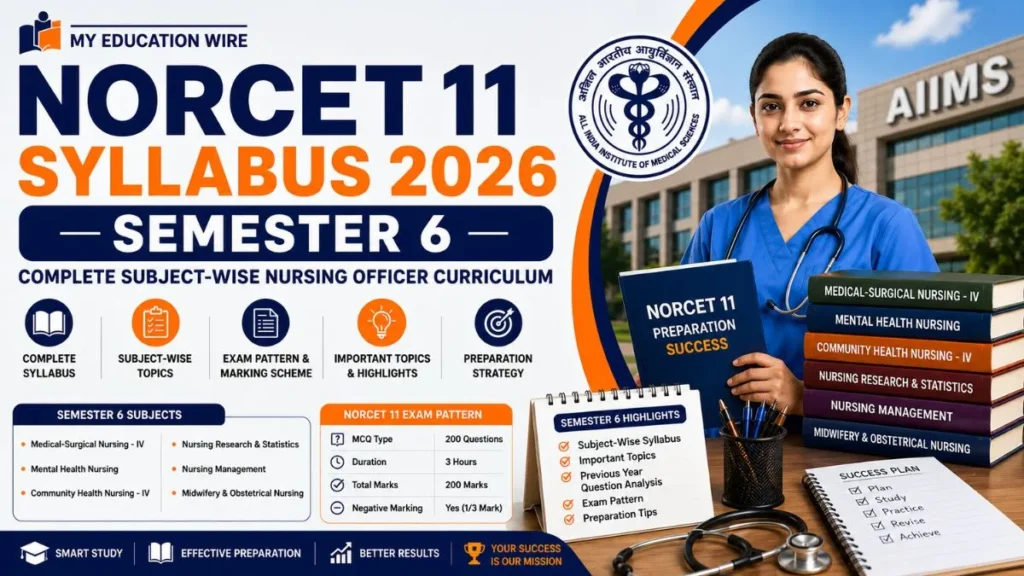
This AIIMS NORCET Syllabus 2026 semester develops advanced nursing competencies.
Child Health Nursing II
Students study congenital anomalies, pediatric surgical conditions, communicable diseases, developmental disorders, autism, ADHD, child welfare services, and pediatric emergency care.
Mental Health Nursing II
Advanced psychiatric nursing includes substance abuse disorders, personality disorders, forensic psychiatry, mental health legislation, crisis intervention, and community mental health programs.
Nursing Management and Leadership
Students learn planning, organizing, staffing, budgeting, quality assurance, disaster management, leadership theories, legal issues, professional ethics, and healthcare administration.
Midwifery and Obstetrical Nursing I
The subject covers reproductive anatomy, fetal development, antenatal care, labor management, fetal monitoring, maternal health indicators, and safe motherhood practices.
Semester VII: Research and Advanced Midwifery
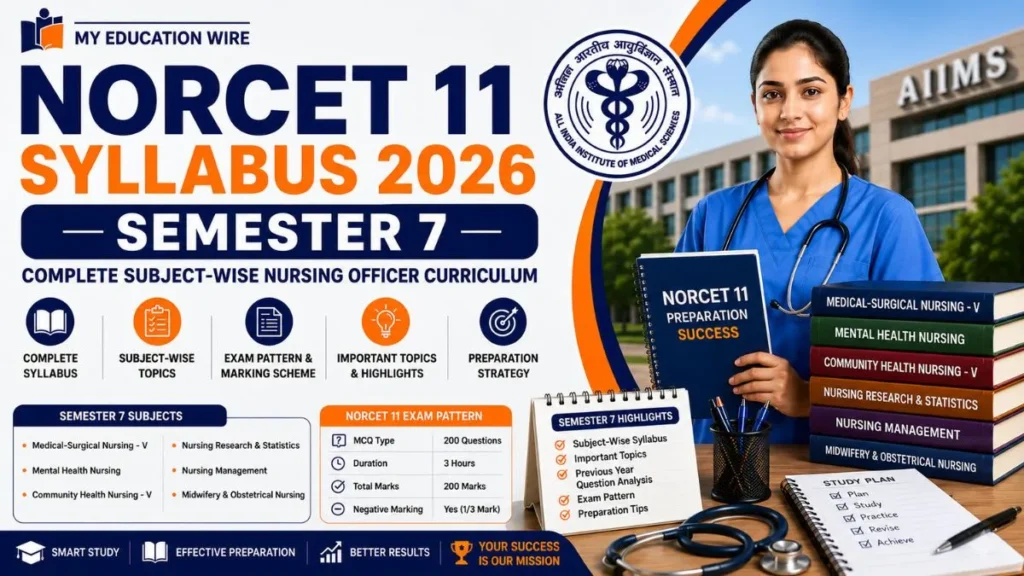
The NORCET 11 Nursing Syllabus 2026 seventh semester focuses on advanced professional practice.
Community Health Nursing II
Students learn referral services, maternal and child health programs, family planning, adolescent health, geriatric care, disaster management, occupational health, biomedical waste management, and health information systems.
Nursing Research and Statistics
This subject introduces research methodology, evidence-based practice, data collection methods, sampling techniques, research ethics, statistical analysis, hypothesis testing, and report writing.
Midwifery and Obstetrical Nursing II
Students gain expertise in managing high-risk pregnancies, obstetric emergencies, postpartum complications, neonatal care, infertility, gynecological disorders, and reproductive health services.
Importance of B.Sc Nursing Syllabus for AIIMS NORCET
The AIIMS Nursing Officer Recruitment Common Eligibility Test (NORCET) heavily emphasizes nursing subjects taught during B.Sc Nursing. Key areas frequently asked in the exam include:
- Anatomy and Physiology
- Microbiology and Infection Control
- Pharmacology
- Pathology
- Medical-Surgical Nursing
- Child Health Nursing
- Mental Health Nursing
- Community Health Nursing
- Obstetrics and Gynecological Nursing
- Nursing Research and Statistics
- Nursing Management
Candidates preparing for NORCET Nursing Exam 2026 should revise semester-wise concepts, clinical procedures, national health programs, pharmacology classifications, pathology mechanisms, and nursing interventions.
In Short
The NORCET 11 Nursing Syllabus 2026 is designed to create competent healthcare professionals capable of providing comprehensive patient care in hospitals, communities, and specialized healthcare settings. From basic anatomy and physiology in the first semester to advanced midwifery, leadership, research, and community health nursing in later semesters, the curriculum provides a complete foundation for professional nursing practice. A thorough understanding of these subjects not only helps students excel academically but also plays a crucial role in competitive examinations such as AIIMS NORCET, ESIC Nursing Officer, RRB Nursing Superintendent, and various state nursing recruitment exams.
MCQ
Semester I MCQs
1. Which anatomical position is considered the standard reference position?
- A. Standing erect with palms facing forward
- B. Standing erect with palms facing backward
- C. Sitting upright
- D. Supine position
- Answer: A
2. The normal resting membrane potential of a neuron is approximately:
- A. +70 mV
- B. -70 mV
- C. -20 mV
- D. +20 mV
- Answer: B
3. Which immunoglobulin can cross the placenta?
- A. IgA
- B. IgM
- C. IgG
- D. IgE
- Answer: C
4. According to psychology, the process of retaining information is called:
- A. Perception
- B. Attention
- C. Memory
- D. Learning
- Answer: C
5. Gram-positive bacteria appear:
- A. Red
- B. Green
- C. Purple/Violet
- D. Yellow
- Answer: C
Semester II MCQs
6. Which hormone lowers blood glucose levels?
- A. Glucagon
- B. Cortisol
- C. Insulin
- D. Adrenaline
- Answer: C
7. The richest source of protein among the following is:
- A. Rice
- B. Egg
- C. Potato
- D. Sugar
- Answer: B
8. The first step of the Nursing Process is:
- A. Planning
- B. Assessment
- C. Evaluation
- D. Implementation
- Answer: B
9. Electronic Health Records (EHR) are primarily used for:
- A. Entertainment
- B. Financial management only
- C. Digital patient documentation
- D. Drug manufacturing
- Answer: C
10. Normal adult body temperature is:
- A. 35°C
- B. 37°C
- C. 39°C
- D. 40°C
- Answer: B
Semester III MCQs
11. The study of disease processes is known as:
- A. Physiology
- B. Pathology
- C. Pharmacology
- D. Histology
- Answer: B
12. Which route avoids first-pass metabolism?
- A. Oral
- B. Sublingual
- C. Rectal
- D. Gastric
- Answer: B
13. Which microorganism causes tuberculosis?
- A. Staphylococcus aureus
- B. Mycobacterium tuberculosis
- C. Streptococcus pneumoniae
- D. Vibrio cholerae
- Answer: B
14. COPD primarily affects the:
- A. Kidneys
- B. Lungs
- C. Heart
- D. Liver
- Answer: B
15. Necrosis refers to:
- A. Programmed cell death
- B. Cell enlargement
- C. Pathological cell death
- D. Cell division
- Answer: C
Also Read NORCET 11 Notification 2026
Semester IV MCQs
16. Which chromosomal abnormality causes Down Syndrome?
- A. Trisomy 18
- B. Trisomy 13
- C. Trisomy 21
- D. Monosomy X
- Answer: C
17. FOBT is used to detect:
- A. Diabetes
- B. Occult blood in stool
- C. Tuberculosis
- D. Kidney stones
- Answer: B
18. The vector of dengue fever is:
- A. Anopheles mosquito
- B. Housefly
- C. Aedes mosquito
- D. Sandfly
- Answer: C
19. IMR stands for:
- A. Infant Mortality Rate
- B. Indian Medical Registry
- C. Internal Medical Report
- D. Infant Morbidity Ratio
- Answer: A
20. Which level of prevention includes vaccination?
- A. Primordial
- B. Primary
- C. Secondary
- D. Tertiary
- Answer: B
Semester V MCQs
21. The FLACC scale is used to assess:
- A. Nutrition
- B. Pain in children
- C. Intelligence
- D. Growth
- Answer: B
22. Piaget is associated with:
- A. Moral development
- B. Cognitive development
- C. Personality development
- D. Social learning
- Answer: B
23. Which disorder is characterized by hallucinations and delusions?
- A. Anxiety disorder
- B. Depression
- C. Schizophrenia
- D. OCD
- Answer: C
24. IMNCI stands for:
- A. Integrated Management of Neonatal and Childhood Illness
- B. Indian Medical Nursing Council Initiative
- C. Integrated Maternal Nutrition Care Initiative
- D. International Medical Nursing Care Index
- Answer: A
25. The Universal Immunization Programme is aimed at:
- A. Adult vaccination only
- B. Preventing vaccine-preventable diseases
- C. Cancer treatment
- D. Mental health promotion
- Answer: B
Semester VI MCQs
26. Tetralogy of Fallot is a:
- A. Gastrointestinal disorder
- B. Congenital heart disease
- C. Neurological disorder
- D. Renal disease
- Answer: B
27. ADHD stands for:
- A. Acute Heart Disease Disorder
- B. Attention Deficit Hyperactivity Disorder
- C. Advanced Developmental Health Deficit
- D. Acute Deficit Hormonal Disease
- Answer: B
28. The Mental Healthcare Act in India was enacted in:
- A. 2012
- B. 2015
- C. 2017
- D. 2020
- Answer: C
29. Which is NOT a management function?
- A. Planning
- B. Organizing
- C. Staffing
- D. Digestion
- Answer: D
30. Leopold’s maneuvers are performed to assess:
- A. Blood pressure
- B. Fetal position
- C. Blood glucose
- D. Cervical cancer
- Answer: B
Semester VII MCQs
31. Evidence-Based Practice (EBP) combines:
- A. Tradition only
- B. Research evidence and clinical expertise
- C. Guesswork
- D. Observation only
- Answer: B
32. Which measure of central tendency is most affected by extreme values?
- A. Median
- B. Mode
- C. Mean
- D. Quartile
- Answer: C
33. Family planning services are included under:
- A. RMNCH+A
- B. TB Control Programme
- C. NPCDCS
- D. RNTCP
- Answer: A
34. Biomedical waste should be segregated:
- A. After disposal
- B. At source of generation
- C. At landfill site
- D. During transport
- Answer: B
35. A hypothesis in research is:
- A. Final conclusion
- B. Statistical table
- C. Tentative statement to be tested
- D. Research report
- Answer: C