
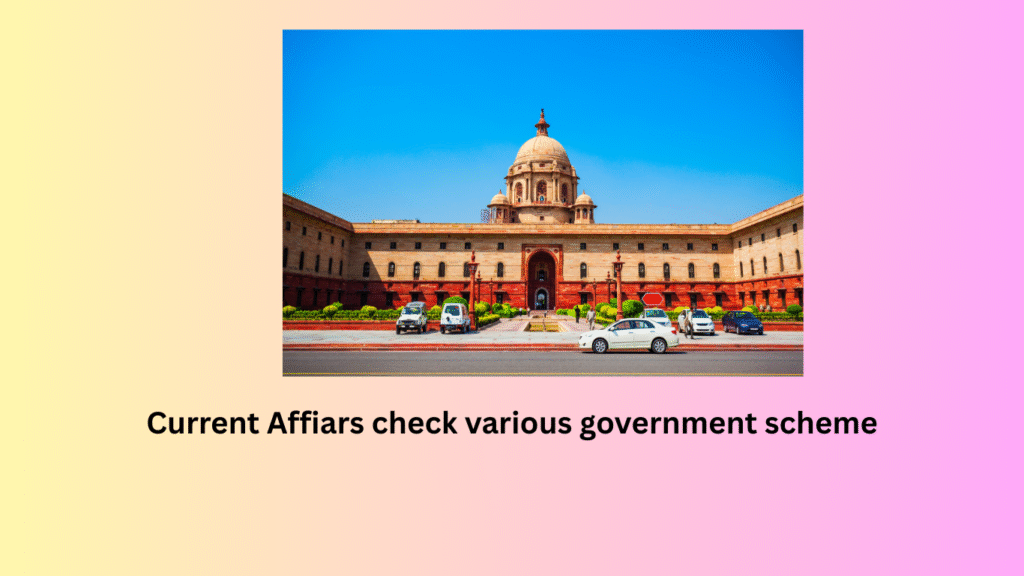
Current Affiars check various government scheme- Check the current affairs happening in India , it gives you fair idea of various scheme offered by government of India and that may help you in your competitive exam
1. Expansion and coverage of PACSs across panchayats
As per the National Cooperative Database (NCD), out of a total of 2,69,230 Gram Panchayats (GPs), 2,51,872 is covering Primary Agricultural Credit Societies (PACS) across the country, as on 30.06.2025.
As per the National Cooperative Database (NCD), the number of uncovered Gram Panchayats (GPs) is 17,358 for PACS, 1,84,387 for Dairy Cooperative Societies, and 2,39,710 for Fishery Cooperative Societies, as on 30.06.2025.
Integration of PACS with cooperative banks
Under the Computerization of PACS project all the functional PACS comes onto an ERP (Enterprise Resource Planning) based Common National Software, linking them with NABARD through State Cooperative Banks (StCBs) and District Central Cooperative Banks (DCCBs). This common ERP software provided to all the PACS in the project, across the country, to capture data on all functionalities of PACS, both credit and non-credit.
The ERP- based common national software enhances the efficiency of PACS operations through a Common Accounting System (CAS) and Management Information System (MIS). Additionally, it strengthens governance and transparency, resulting in faster loan disbursal, reduced transaction costs, minimized payment imbalances, and seamless accounting with DCCBs and StCBs.
To enhance data security, cyber security, and inter-operability among cooperative banking systems, An umbrella organization named National Urban Co-operative Finance and Development Corporation (NUCFDC) for urban co-operative banks.
The objective is to accelerate the digitisation of cooperative banks by leveraging collective strengths, fostering collaboration, promoting innovation, and ensuring that member banks be prepared to navigate the complexities of the digital era effectively.
Further, to provide technological services to Rural Cooperative Banks (RCBs) and for their strengthening, RBI has given in-principal approval to NABARD for setting up of Sahakar Sarathi (Shared Service Entity).
2.COORDINATION FOR SUSTAINABILITY AND CIRCULAR ECONOMY IN COOPERATIVE DAIRY SECTOR
Dairy is the largest agricultural product in India, contributing 3.5% to the national economy (as per National Accounts Statistics). In 2023-24, India’s milk production stood at 239.3 million metric tonnes (MMT), representing 25% of global production. About 88 MMT (37%) consumed at the producer level, leaving a marketable surplus of 150 MMT.
Of this surplus, the organised sector handles only 32% (47 MMT) while the remaining 68% (102 MMT) lies with the unorganised sector. The cooperative sector accounts for 56% (26 MMT) of milk handled in the organised segment.
The Ministry of Cooperation has launched White Revolution 2.0, a cooperative-led initiative aimed at expanding cooperative coverage, generating employment and empowering women, while embedding sustainability and circularity in the dairy sector. By the end of the fifth year, i.e., 2028-29,
The milk procurement by dairy cooperatives aims to reach 1007 lakh kg per day. While the Standard Operating Procedure (SOP) for White Revolution 2.0 launched on 19 September 2024, White Revolution 2.0 formally came into existence on 25.12.2024
3..Veterinary Care in Remote Areas of Odisha
Animal Husbandry is State subject and state is doing the establishment of Veterinary Hospitals and Staffing depending on their requirement based on the parameters like geographical status, disease epidemiology, animal profile etc.
As per information received from the State of Odisha, there are 541 Veterinary Hospitals in the state of Odisha including 126 in Tribal areas. Additionally, total 314 Mobile Veterinary Units including 121 in Tribal areas are also operational under the State Scheme of Odisha.
Presently, there is call center where executive as well as Veterinary Doctors are stationed to help the farmers through toll free no 1962.
4.Rashtriya Gokul Mission and Livestock Development in Jharkhand
In order to complement and supplement the efforts of the State and Union Territories for conservation and promotion of indigenous breeds, Government of India is implementing Rashtriya Gokul Mission (RGM) since December 2014 for development and conservation of indigenous breeds, genetic upgradation of bovine population and enhancement of milk production and productivity across the country including Jharkhand.
The benefit of the scheme is accruing to all the dairy farmers in the country including famers of Jharkhand State.
Nationwide Artificial Insemination Programme: The programme aims at enhancing AI coverage and to deliver quality Artificial Insemination Services (AI) at farmer’s doorstep with semen of high genetic merit bulls including indigenous breeds.
The progress of the programme uploaded online on Bharat Pashudhan/ NDLM (National Digital Livestock Mission) on real time basis and transparency of the artificial insemination and farmer benefitted from the programme ensured.
Asofn date, in Jharkhand, 26.87 lakh animals covered, performance of 36.06 lakh artificial insemination and 18.20 lakh farmers get the benefit under the programme.
Current Affiars check various government scheme
5.Matsya Yojana
under PMMSY, the Department have taken up a transformative initiative to develop existing 100 Coastal Fishermen Villages(CFV) situated close to the coastline in all costal States and Union Territories (UTs) as Climate Resilient Coastal Fishermen Villages (CRCFV) and to make them as economically vibrant fishermen villages. Under this, department has identified 100 villages based on the guidelines, jointly with the respective states/UTs. Interventions under this component are tailored to local needs to enhance climate resilience based on the gap analysis studies.
The development of CRCFV is a Central Sector Scheme Component of the PMMSY with a unit cost of Rs. 200 lakh per fishing village, and Government of India is meeting the entire cost (100%)
The Pradhan Mantri Matsya Sampada Yojana under the Department of Fisheries. Government of India, in coordination with the State Governments and UT Administrations, promotes hygienic fishing and fish handling practices through support for quality fish production, species diversification, promotion of export-oriented species, branding, standardisation and certification. Creation of post-harvest infrastructure with emphasis on seamless cold chain and development of modern fishing harbours and fish landing centers.
Training and Awareness to stakeholders including on hygienic handling practices on-board fishing vessels and in the farms to maintain quality standards is a thrust area of the scheme
. Under PMMSY, 58 fishing harbours and fish landing centres at a total outlay of Rs. 3281.31 crore approved including modernisation and upgradation of existing fishing harbours.
In addition, Rs.1568.11 crore has been approved for the construction of 734 ice plant/cold storages,
The 192 fish retail markets, 21 Modern Wholesale fish markets, 6410 fish kiosks including ornamental kiosks and 134 value-added enterprise units. Further the Department of Fisheries, Government of India has also sanctioned 27,297 units of post-harvest fish transportation facilities viz., refrigerated (375) and insulated trucks (1407), Live Fish Vending Centres (1265), auto rickshaws (3915), motor cycles (10924) and bicycles with ice box (9412) at a total cost of Rs. 835.27 crore.
Additionally, Sagar Mitras deployed in coastal villages to educate fishers on hygienic handling, personal hygiene, and sustainable fishing methods.
5.Rashtriya Karamyogi Jan Seva Programke
Ministry of Parliamentary Affairs actively taking part in Rashtriya Karmayogi initiative to build a stronger spirit of service
The Rashtriya Karmayogi Jan Seva Programme is a large-scale behavioural training programme for Capacity Building Commission for Central Government employees. It aims to instil a spirit of public service (seva bhaaw) and a sense of satisfaction in the work, government employees perform.
To implement this, Master Trainers (MTs) have been trained in all the Ministries/Departments through a three-days capacity-building workshops. The Master Trainers, in turn, have been training all the employees of their Ministry/Department in batches of 30–35 officials. The programme uses interactive learning methods rooted in the context of the government servant.
6.ECOSYSTEM (NAMASTE) SCHEME
National Action for Mechanized Sanitation Ecosystem (NAMASTE) scheme is a Central Sector Scheme for the welfare of Sewer and Septic Tank Workers (SSWs). NAMASTE scheme has been launched in July, 2023. Waste Pickers added as a target group under the scheme in June, 2024.
Progress made under NAMASTE scheme are as under:
(i) 84,902 Sewer and Septic Tank Workers (SSWs) have been validated.
(ii) 45,871 PPE kits for SSWs & 354 Safety Devices Kit for Emergency Response Sanitation Units have been issued to States/UTs.
(iii) 54,140 beneficiaries have been covered under Ayushman Bharat –PMJAY and State health scheme.
(iv) Capital Subsidy of Rs. 20.36 Crore released to 707 sanitation workers and their dependents for sanitation related projects.
(v) 1089 workshops have been conducted on Prevention of Hazardous Cleaning of Sewer and Septic Tanks.
7.PM Janman
Prime Minister launched Pradhan Mantri Janjati Adivasi Nyaya MahaAbhiyan (PM JANMAN) for socio-economic development of 75 PVTG communities residing in 18 states and one UT. The mission aims to provide basic facilities to improve their socio-economic conditions such as safe housing, clean drinking water and improved access to education, health and nutrition, road and telecom connectivity, electrification of unelectrified households and sustainable livelihood opportunities in 3 years.
These objectives are being met through 11 interventions implemented by 9-line Ministries. Each Ministry under abhiyan is responsible for implementing the intervention assigned to it.
In view of the implementation of the PM JANMAN, the Ministry of Tribal Affairs through the State Governments/ UT Administration/departments has undertaken habitation level data collection exercise through PM Gati Shakti mobile application to estimate PVTG population figures and infrastructure gaps in order to cover PVTG population residing in villages & habitations under PM JANMAN.
Current Affiars check various government scheme
8.DAJGUA
DhartiAabaJanjatiya Gram Utkarsh Abhiyan (DAJGUA), is a transformative initiative to drive inclusive and sustainable development in tribal regions. The Abhiyan comprises of 25 interventions and 17 ministries are implementing it and aims to saturate infrastructural gaps in 63,843 villages, improve access to health, education, housing, electrification, telecommunication and providing livelihood opportunities benefiting more than 5 crore tribals in 549 districts and 2,911 blocks in 30 States/UTs in 5 years.
Contributors
| Ministry of Power | House electrification (Revamped Distribution Sector Scheme – RDSS) | |
| 2 | Ministry of New and Renewable Energy | Off grid connection, solar power scheme |
| 3 | Department of Communications (Ministry of Communications) | 4 G/5 G network – Universal Service Obligation Fund (USOF) |
Current Affiars check various government scheme
9. DAPST Scheme
Government is implementing Development Action Plan for Scheduled Tribes (DAPST) as a strategy for the development of Scheduled Tribes and areas having tribal concentration in the country.
Besides Ministry of Tribal Affairs, 41 Ministries/Departments are allocating certain percentage of their total scheme budget every year for tribal development under DAPST to bridge the developmental gap between Scheduled Tribes (STs) and non-ST populations and for various tribal development projects relating to education, health, agriculture, irrigation, roads, housing, electrification, employment generation, skill development, etc.
At present, all eligible elderly persons are getting the pension, including members of the Scheduled Tribes,Department of Rural Developement through National Social Assistance Programme (NSAP) is implementing. Under the Indira Gandhi National Old Age Pension Scheme (IGNOAPS) component of NSAP, assistance is given to persons belonging to households below the poverty line, who are 60 years of age and above.
10. NESTs
National Education Society for Tribal Students (NESTS), an autonomous body managing the Eklavya Model Residential Schools (EMRS) in coordination with State EMRS Societies, has issued comprehensive guidelines to ensure the health, hygiene, and overall well-being of students.
Under the Recurring Grant-in-Aid (General), NESTS has allocated ₹1,09,000 per student per annum up to FY 2024–25, enhanced to ₹1,47,062 from FY 2025–26, covering operational and maintenance costs.
It includes medical expenses, CBSE fees, stationery, school bags, and sanitary napkins. Specific guidelines framed for the engagement of cooks and mess helpers to provide nutritious food in a healthy environment.
The EMRS infrastructure includes separate hostels for boys and girls with dedicated living and dining areas, adequate toilets, bathing units, safe potable water, drainage, and waste disposal facilities in line with construction norms. Further, each EMRS has one counsellor and one female staff nurse to address students’ psychological and physical health needs.
EMRSs across the country are equipped with separate toilets for boys and girls. All girl students get sanitary napkins, and in several states, sanitary napkin vending machines and incinerators have also been installed in girls’ hostels and toilets to promote hygiene and convenience.